
ERP for Professional Services: Why Modern Firms Need It

Professional services companies face a unique set of challenges. Unlike product-based businesses, the value they deliver is tied to time, expertise, and the ability to manage client expectations. That means every project, invoice, and hour logged directly impacts profitability. When operations are handled across scattered spreadsheets, basic project tools, and multiple apps, inefficiency becomes inevitable. This is where Enterprise Resource Planning (ERP) systems step in.
ERP is no longer reserved for manufacturing or logistics-heavy industries. Over the last decade, it has proven to be a powerful ally for professional services firms – consultancies, agencies, law offices, and software development companies. By bringing all core functions into one system, ERP allows teams to focus on what really matters: delivering value to clients while maintaining financial stability.
Why ERP Matters for Professional Services
Professional services rely heavily on resource management, accurate billing, and clear communication. Without a centralized system, small inefficiencies can quickly add up. A project may run over budget simply because time tracking was inconsistent. Revenue may be delayed because invoices weren’t sent on time. Employees may struggle to collaborate if files and updates are spread across multiple tools.
ERP simplifies this complexity. Instead of using one app for project management, another for finance, and yet another for HR, everything sits in a single platform. Leaders gain real-time insight into performance, employees have clear visibility of their responsibilities, and clients benefit from smoother project delivery. For service-based firms where margins are often slim, that level of control can make a decisive difference.
Key Benefits of ERP in Professional Services
- Stronger Financial Management – With automated invoicing, expense tracking, and revenue forecasting, companies can maintain healthier cash flow.
- Improved Project Delivery – ERP links resources, budgets, and schedules, reducing the risk of overruns.
- Better Resource Allocation – Managers can see who is overbooked, who has free capacity, and adjust accordingly.
- Client Transparency – Clear reporting and accurate billing strengthen trust.
- Scalability – As a firm grows, ERP adapts, supporting larger teams and more complex projects without adding unnecessary overhead.
These advantages explain why more professional services firms are moving away from standalone tools and toward integrated ERP solutions. But the question remains: which system should you choose?
Top ERP Solutions for Professional Services
There’s no one-size-fits-all answer. The best ERP for your firm depends on size, budget, industry focus, and growth stage. Below are some of the leading options used by professional services firms today.
Grade
Grade is a business management platform that combines project management, finance, HR, and sales in one system. It is designed to help companies avoid switching between multiple apps by offering integrated features in a single interface. The platform includes tools for invoicing, recruiting, and financial analytics, aiming to simplify everyday operations. While still gaining recognition compared to larger ERP providers, Grade continues to expand its functionality, especially in the area of advanced analytics.

Productive
Productive is well-regarded among agencies and consultancies. It combines project management, time tracking, budgeting, and reporting in one platform. One of its key strengths is profitability tracking, allowing managers to see whether projects are truly generating value. For teams that want a solution tailored to service-based work, Productive is often a strong fit.

Oracle NetSuite
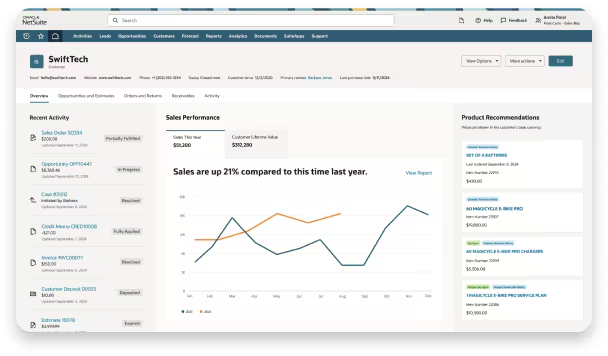
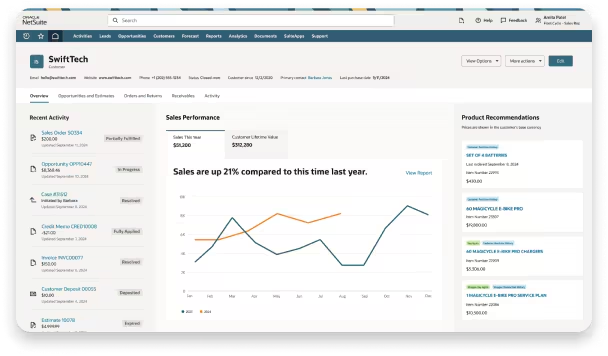
As one of the most recognized names in ERP, Oracle NetSuite offers a broad set of tools covering financials, CRM, resource planning, and reporting. Its cloud-based system scales easily, making it a strong choice for mid-sized and large service firms. However, its complexity and cost can make it less accessible to smaller agencies or companies just starting to standardize their processes.
Microsoft Dynamics 365
Microsoft Dynamics 365 blends ERP and CRM functions and integrates seamlessly with other Microsoft tools. This makes it especially attractive for companies already invested in the Microsoft ecosystem. It provides features for sales, project automation, and finance. While flexible, it may require more customization compared to service-specific solutions.
SAP Business One
SAP Business One is aimed at small and mid-sized companies looking for a reliable ERP foundation. It covers financial management, project tracking, and reporting. Many firms appreciate its scalability and strong support, though it may require additional configuration to fit the unique workflows of professional services businesses.

Choosing the Right ERP
The decision doesn’t come down to which system has the longest list of features. Instead, it’s about alignment. A smaller consulting firm may prefer an ERP that emphasizes usability and quick setup. A larger organization might prioritize deep financial analytics and advanced customization.
Before committing, it’s worth mapping out your current pain points. Are projects overrunning budgets? Is billing slowing down? Do you lack visibility into staff workloads? The right ERP should address these issues directly. In many cases, professional services firms benefit from platforms that balance project management and finance, since both functions are closely tied to profitability.
The Road Ahead
Professional services will continue to evolve. Clients expect faster delivery, greater transparency, and measurable outcomes. Firms that still rely on fragmented tools risk falling behind, while those that adopt ERP systems position themselves for sustainable growth.
Whether you choose an established enterprise platform like NetSuite, a specialized solution like Productive, or a growing all-in-one option like Grade, the main priority is integration. A connected system reduces waste, improves accuracy, and ensures that teams spend less time juggling admin and more time delivering value.
For companies in the professional services space, ERP is no longer a luxury. It’s becoming the backbone of competitive advantage.
you achieve your goals!

How ERP Helps HR Departments Optimize Labor Costs and Performance

Mastering large project management: tips and tools

Why upgrading your reporting system is a game-changer


How ERP Streamlines Client Feedback, Speeds Up Revisions, and Simplifies Approvals